
VAWA in deportation proceedings: cancellation, motions to reopen, arrests and detention
Being in immigration court does not shut the VAWA door. A judge can grant VAWA cancellation of removal, a removal order can be reopened for VAWA relief, and domestic violence convictions can sometimes be waived for a survivor. Each tool has strict conditions. This article sets them out, and what to do first if you have been arrested or detained.
Current as of October 2026. We re-check this page every quarter and after any change in the law.
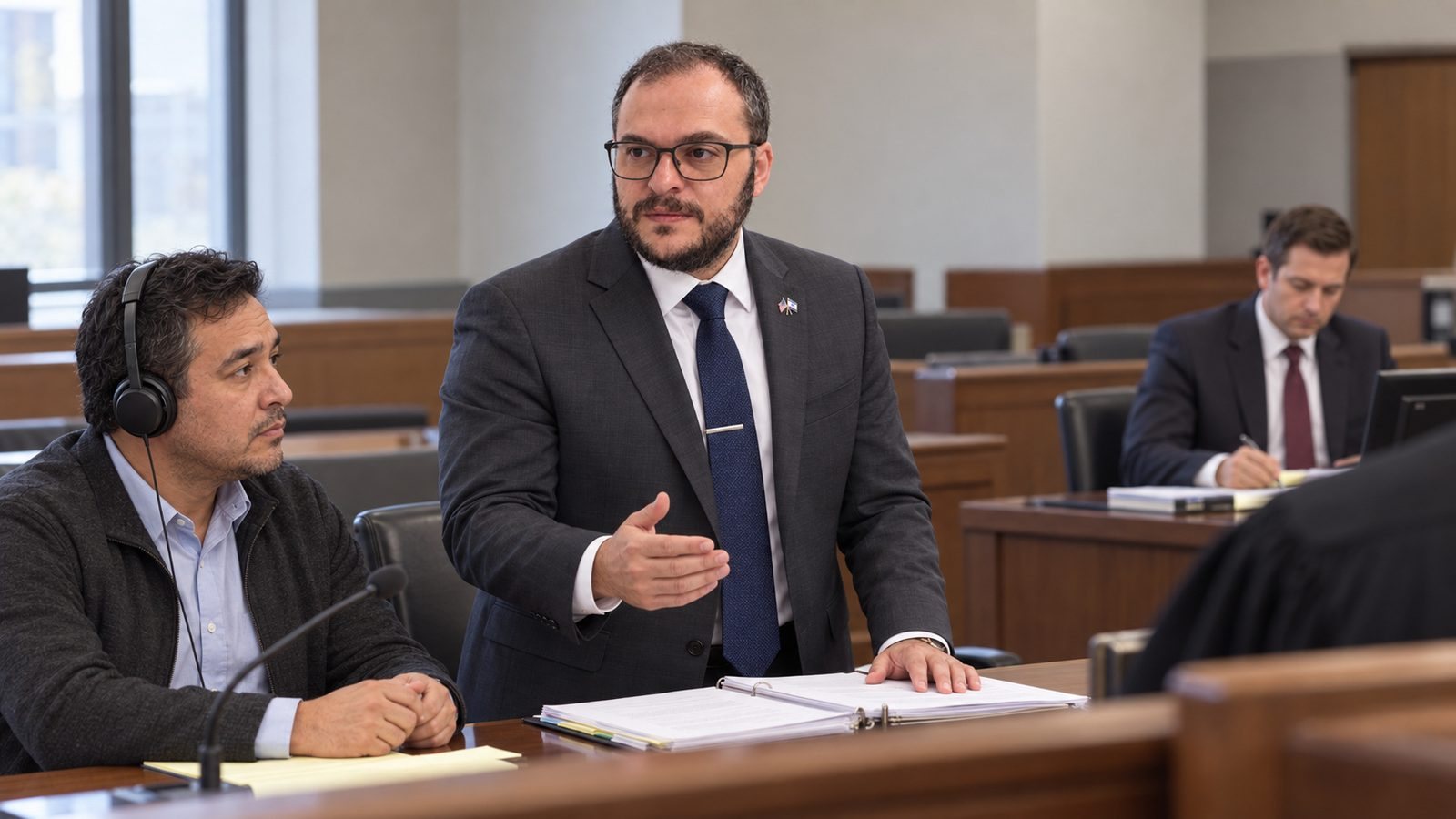
Abusers often use the immigration court as a threat: "If they put you in proceedings, it is over." It is not. Congress built VAWA tools into removal proceedings themselves. Some are defenses you raise before the judge. One reopens a case that is already closed. Another waives the very convictions an abuser can engineer by calling the police first.
Court cases move on deadlines, and missing one can end the case. If you have a hearing notice, a removal order, or a family member in ICE custody, read this article for the map, then call a lawyer the same day. Our general page is VAWA in immigration court.
VAWA cancellation of removal

VAWA cancellation lets an immigration judge cancel removal and grant permanent residence to a survivor of abuse (INA 240A(b)(2)). You must show:
- That you were battered or subjected to extreme cruelty by a spouse or parent who is or was a U.S. citizen or permanent resident, or that you are the parent of a child abused by such a parent. An intended spouse, who married in good faith but whose marriage was invalid only because of the abuser's bigamy, also qualifies (INA 240A(b)(2)(A)(i)).
- 3 years of continuous physical presence immediately before the application (INA 240A(b)(2)(A)(ii)).
- Good moral character during that period (INA 240A(b)(2)(A)(iii)).
- That you are not inadmissible under INA 212(a)(2) or (3), not deportable under 237(a)(1)(G), (2), (3) or (4) (the deportability limits are subject to the 237(a)(7) waiver authority in paragraph (5)), and have no aggravated felony conviction (INA 240A(b)(2)(A)(iv)).
- That removal would cause extreme hardship to you, your child or your parent (INA 240A(b)(2)(A)(v)).
The judge must consider any credible evidence (INA 240A(b)(2)(D)).
Hardship here, not in the self-petition
Extreme hardship is a real element of VAWA cancellation. It is not an element of the VAWA self-petition: Congress removed it from INA 204(a)(1) in 2000 (Pub. L. 106-386, div. B, title V, sec. 1503(b)(1)(A)), even though 8 C.F.R. 204.2(c)(1)(i)(G) still prints it. Do not let one case's standard spill into the other.
The 3-year clock
In other kinds of cancellation, service of a Notice to Appear can stop the clock (INA 240A(d)(1)(A)). VAWA cancellation is different. The statute says the issuance of a charging document does not toll the 3 years, and the stop-time rule's notice prong expressly excepts VAWA cancellation applicants (INA 240A(b)(2)(A)(ii); 240A(d)(1)(A)). The offense prong still applies: the period ends when you commit an offense referred to in INA 212(a)(2) that makes you inadmissible or removable (INA 240A(d)(1)(B)). The offense stops time when it is committed, not when there is a conviction (Matter of Perez, 22 I&N Dec. 689 (BIA 1999)).
Absences connected to the abuse do not break continuous presence, and connected time does not count toward the 90-day or 180-day limits. But that excluded time does not count toward the 3 years either (INA 240A(b)(2)(B)).
Good moral character, and the abuse connection
The statutory bars to good moral character are in INA 101(f). For VAWA cancellation there is an exception: an act or conviction that does not otherwise bar relief does not bar a good moral character finding if it was connected to the battery or extreme cruelty and a waiver is otherwise warranted (INA 240A(b)(2)(C)). Two or more DUI convictions during the period create a presumption against good moral character (Matter of Castillo-Perez, 27 I&N Dec. 664 (A.G. 2019)).
Limits
- The general cancellation bars in INA 240A(c), including the bar on anyone previously granted cancellation, suspension of deportation or 212(c) relief, by their text apply to subsections (a) and (b)(1), not to VAWA cancellation under (b)(2). Tell your lawyer about any earlier grant of relief.
- Grants count against a cap of 4,000 a year (INA 240A(e)(1), (e)(3)).
- The government filing fee for Form EOIR-42B is $1,640 for filings postmarked on or after February 1, 2026 ($100 to EOIR plus $1,540 added by the 2025 reconciliation law), plus a $30 biometrics fee (EOIR Forms and Fees page; 91 FR 2561). None of it is a legal fee. A related work permit application under 8 C.F.R. 274a.12(c)(10) and Form I-824 carry no USCIS fee for VAWA cancellation applicants (8 C.F.R. 106.3(b)(8)).
If cancellation is granted, the statute directs parole for the applicant's child, or for the parent of a child who was granted it (INA 240A(b)(4)(A)).
Published VAWA cancellation decisions include Lopez-Birrueta v. Holder, 633 F.3d 1211 (9th Cir. 2011), on threats and control; Da Silva v. Attorney General, 948 F.3d 629 (3d Cir. 2020), on court review of an extreme cruelty finding; and Ruiz v. U.S. Attorney General, 73 F.4th 852 (11th Cir. 2023). None was our client. See VAWA cancellation and real cases.
A self-petition or U petition while you are in court
You can file a VAWA self-petition with USCIS while removal proceedings are pending. One trap matters here. A marriage entered while you were in removal proceedings bars approval of a self-petition unless you lived abroad for 2 years after the marriage, or prove the marriage was in good faith by clear and convincing evidence, with the exemption requested in writing with the I-360 (INA 204(g); 3 USCIS-PM D.2(D)).
A U petition is also filed with USCIS, even from proceedings, and ICE may agree to a joint motion to terminate without prejudice (8 C.F.R. 214.14(c)(1)(i)). The Board of Immigration Appeals has said a judge should generally continue proceedings for a U petition that looks approvable on its face (Matter of Sanchez Sosa, 25 I&N Dec. 807 (BIA 2012)). A person with a final order may still file, but filing does not stop removal; a stay can be requested (8 C.F.R. 214.14(c)(1)(ii); 8 C.F.R. 241.6).
If you were a conditional resident and USCIS terminated your status, you can seek review in proceedings, where DHS must prove by a preponderance that the facts supporting termination are true (INA 216(b)(2), (c)(3)(D); 8 C.F.R. 216.4(d)(2), 216.5(f)). A denied battered-spouse I-751 waiver is reviewed by the judge (Matter of Stowers, 22 I&N Dec. 605 (BIA 1999)). Our comparison of these paths is in VAWA, the U visa, or the I-751 waiver.
The VAWA motion to reopen
If you already have a final removal order, a special motion to reopen can bring the case back for VAWA relief. It applies to relief based on a VAWA self-petition (INA 204(a)(1)(A)(iii), (iv), (B)(ii), (iii)), cancellation under 240A(b), or former INA 244(a)(3) (INA 240(c)(7)(C)(iv)). The abused-parent petition under INA 204(a)(1)(A)(vii) is not on that list. The conditions:
- It is filed together with the cancellation application or a copy of the self-petition.
- It is filed within 1 year of the final order. The judge can waive that limit for extraordinary circumstances or extreme hardship to your child.
- You are physically present in the United States when you file.
- The usual one-motion limit does not block one such motion.
The most misunderstood point is the stay. Filing stays removal only for a person who is a "qualified alien" under 8 U.S.C. 1641(c)(1)(B), and only if the motion establishes that status. For that person, the stay lasts through final disposition, including appeals (INA 240(c)(7)(C)(iv), closing sentence). Anyone else may need to ask for a stay separately. See the VAWA motion to reopen.
After an arrest

Abusers sometimes call the police first, file a cross-complaint, or seek a protective order against the survivor. The criminal case and the immigration case then run together, and what happens in one shapes the other.
Talk to your criminal lawyer first
Before you plead to anything, and before you write anything down about the arrest, talk to your criminal lawyer and make sure they know your immigration situation. See arrested or charged.
Two rules help survivors with a record:
- The 237(a)(7) waiver. The immigration judge may waive deportability for a crime of domestic violence or stalking, or a protection-order violation. You must have been battered or subjected to extreme cruelty and must not be, and not have been, the primary perpetrator in the relationship. The judge must also find that you acted in self-defense; or violated an order meant to protect you; or committed a crime that caused no serious bodily injury and was connected to the abuse. The judge is not limited to the criminal court record and considers any credible evidence (INA 237(a)(7)(A)-(B)). See the domestic violence waiver.
- Good moral character. For the self-petition, an act or conviction connected to the abuse does not bar good moral character if it is waivable for purposes of the petition (INA 204(a)(1)(C); INA 101(f)). For VAWA cancellation, see the exception in INA 240A(b)(2)(C) above.
Where the arrest happened matters
If an enforcement action leading to removal proceedings took place at a domestic violence shelter, rape crisis center, supervised visitation center, family justice center, victim services provider or community-based organization, or at a courthouse where you were appearing in a protection-order, custody or other domestic violence case, the Notice to Appear must state that 8 U.S.C. 1367 was complied with (INA 239(e)). Tell your lawyer exactly where and when you were picked up. See enforcement at protected places.
If you or a family member is detained

Detention compresses every deadline. The VAWA tools above remain available, but the case moves faster and evidence is harder to gather from inside. What to do first:
- Get a lawyer involved immediately, and give them the person's full name, date of birth and the facility.
- Do not sign anything you do not understand, including a stipulated removal order or voluntary departure papers, without a lawyer.
- Tell the lawyer about the abuse early. It may change which relief is available and how the case is presented.
- Ask someone safe to gather documents from outside, without going through the abuser.
Your information in a VAWA, T, U or VAWA cancellation case is protected by the federal nondisclosure rule, with limited exceptions (8 U.S.C. 1367(a)(2)). That rule does not stop anyone from calling ICE; that is our reading of its scope. Read VAWA confidentiality under 8 U.S.C. 1367 and detained survivor.
Safety
A safety plan is made with a domestic violence advocate. The National Domestic Violence Hotline is 1-800-799-7233, or text START to 88788. If you are in danger now, call 911.
Read next: VAWA in immigration court, VAWA cancellation, the VAWA motion to reopen, or detained survivor.
Common questions
What is the difference between VAWA cancellation and the VAWA self-petition?
The self-petition is filed with USCIS on Form I-360. VAWA cancellation is decided by an immigration judge in removal proceedings under INA 240A(b)(2). Cancellation requires 3 years of continuous physical presence and extreme hardship to you, your child or your parent; the self-petition requires neither.
I have an old removal order. Can VAWA help?
Possibly. A VAWA motion to reopen can be filed within 1 year of the final order, with a VAWA cancellation application or a copy of the self-petition, while you are physically present in the United States. The 1-year limit can be waived for extraordinary circumstances or extreme hardship to your child (INA 240(c)(7)(C)(iv)).
Does filing a VAWA motion to reopen stop my deportation?
Only in a narrow case. Filing stays removal only for a person who is a qualified alien under 8 U.S.C. 1641(c)(1)(B), and only if the motion establishes that status. The stay then lasts through final disposition, including appeals (INA 240(c)(7)(C)(iv), closing sentence). Talk to a lawyer the same day.
I was convicted of a domestic violence offense, but the abuser was the one hurting me. Is there a way out?
The immigration judge may waive deportability for a domestic violence or protection-order offense if you were battered or subjected to extreme cruelty, were not the primary perpetrator, and the judge finds self-defense, a violation of an order meant to protect you, or a crime connected to the abuse that caused no serious bodily injury (INA 237(a)(7)). Talk to your criminal lawyer before writing anything down.
How much does it cost to apply for VAWA cancellation?
As of October 2026, the government filing fee for Form EOIR-42B is $1,640 for filings postmarked on or after February 1, 2026, plus a $30 biometrics fee (EOIR Forms and Fees page; 91 FR 2561). That is not a legal fee. Check the EOIR fees page before filing.
The lawyers who will handle your case
One of them calls you back, privately, on your terms.


Talk to a lawyer privately. You decide how we reach you.
Tell us a safe number or email and a safe time, and whether we can leave a message. We never contact the person who hurt you, and we never call from a number or send anything that names this site. The first conversation is free and confidential, in English, Russian, Spanish or Uzbek, with a live interpreter for any other language.