
How abusers use immigration status as control, and what the law says
When one partner has papers and the other does not, status becomes a weapon. Abusers hide passports, threaten to call ICE, refuse to file or withdraw petitions, and control every dollar. Each of these tactics has an answer in the law, and each is also evidence of the abuse itself.
Current as of October 2026. We re-check this page every quarter and after any change in the law.
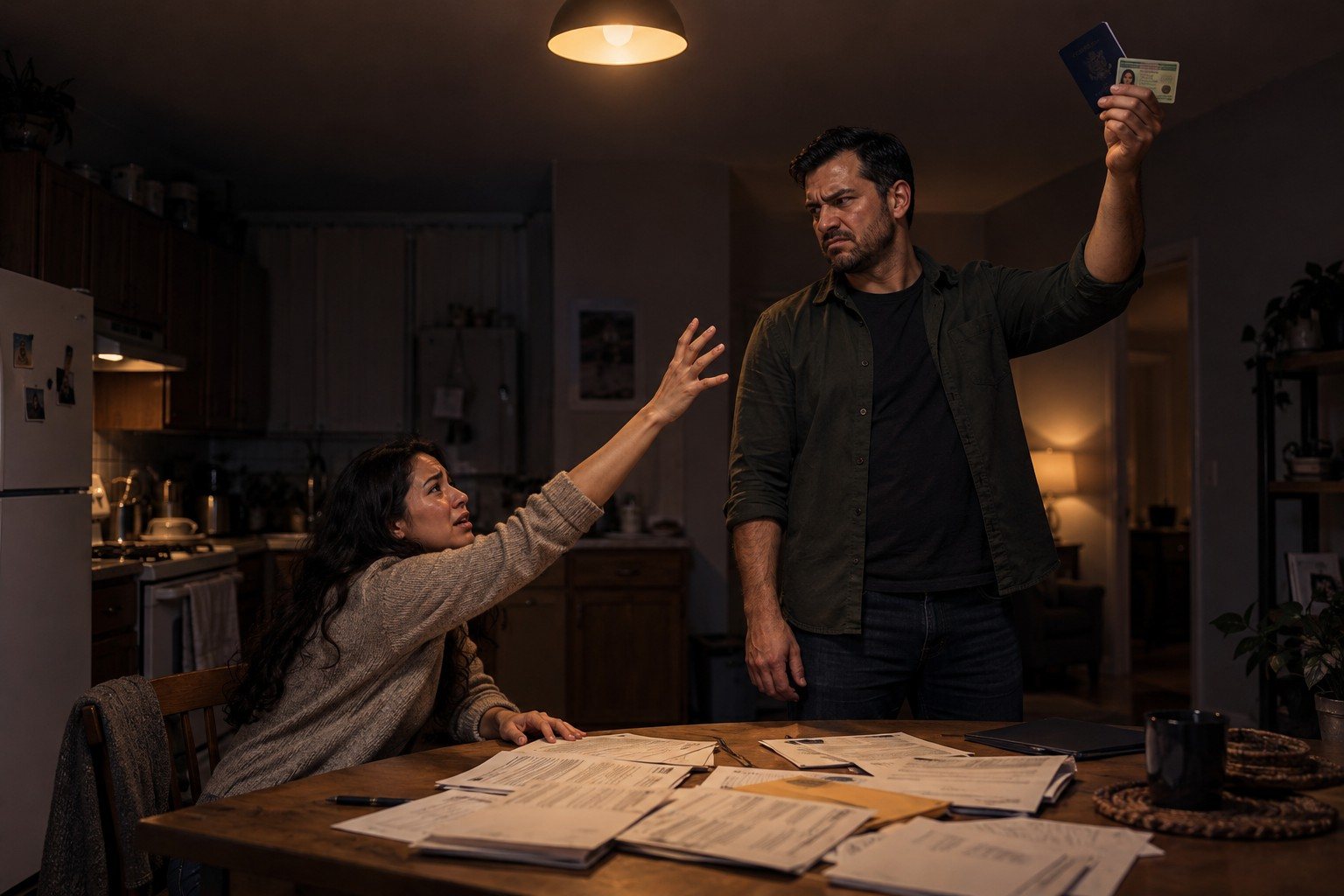
Advocates call it immigration-related abuse: using a partner's status, papers or fear of deportation to control them. It is common, and it works because it sounds like law. "Without me you have nothing." "One phone call and you are gone." "I will cancel your papers." Many survivors believe these lines for years, because the abuser is the one who filed, who holds the documents, who speaks the language, and who seems to know how the system works.
This article takes the most common tactics one at a time. For each, it says what the law actually provides, with the citation, and how the tactic itself becomes part of the evidence in a VAWA case. If you see your own life here, the self-petition may be open to you: read the complete guide next.
Before you read further
If someone checks this device, read staying safe online. The Quick Exit button at the top of the page replaces this tab. A safety plan is made with a domestic violence advocate. If you are in danger now, call 911.
First, why these tactics count as abuse

The abuse element of a VAWA self-petition is "battery or extreme cruelty." The regulation defines it to include psychological abuse, threatened acts of violence, and acts that may not initially appear violent but are part of an overall pattern of violence (8 C.F.R. 204.2(c)(1)(vi)). Courts have read extreme cruelty to reach non-physical, coercive control, judged across the whole relationship. The Ninth Circuit said so in Hernandez v. Ashcroft, 345 F.3d 824 (9th Cir. 2003), a published decision (not our client).
Since USCIS revised its guidance in December 2025, the Policy Manual adds that hurtful conduct alone, or adverse interactions of limited severity, is not enough for "extreme" cruelty; the conduct must reflect an intent to gain or maintain power and control. Its own examples include forced confinement or isolation, physical control, and denying access to food, family or medical care (3 USCIS-PM D.2(E)(1)). Describe immigration-related abuse in those terms: what the abuser controlled, how, and for how long.
So the tactics below do two things at once. They are obstacles the law has answers to. And, described with dates and detail, they are evidence of the pattern. One tactic alone may not meet the standard. Several together, over time, with their effect on you, often show the officer what the relationship was. See abuse without violence.
1. Withholding your passport, green card or papers

The tactic. The abuser keeps your passport, your green card, your marriage certificate, your children's birth certificates, or your mail. Sometimes they destroy them. Without papers, you feel you cannot leave, work or prove who you are.
What the law says. USCIS must consider any credible evidence, not only original documents, and decides the weight (INA 204(a)(1)(J); 8 C.F.R. 204.2(c)(2)(i)). Since PA-2025-33 (Dec. 22, 2025), USCIS asks for primary evidence of the marriage, such as the certificate and proof that all prior marriages ended. Those are public records, and copies can usually be ordered from the office that issued them without asking the abuser for anything.
You also have to show the abuser's citizenship or green card status, and the abuser may be holding that proof too. Where you have no documents, you can give identifying details, such as the abuser's name, date and place of birth and Social Security number, and USCIS searches its own records; the burden of proof stays with you (3 USCIS-PM D.2(B)(1)).
As evidence. Describe what was taken, when, how you asked for it back, and what the abuser said. That description is part of the pattern. See documents the abuser took and evidence without documents.
2. Threats to call ICE or have you deported

The tactic. "I will call immigration." "I will tell them you married me for a green card." Sometimes the abuser actually calls, or writes to USCIS.
What the law says. DHS, the Justice Department and the State Department may not make an adverse determination of admissibility or deportability using information furnished solely by the abuser, or by a household family member who abused you with the abuser's consent or acquiescence (8 U.S.C. 1367(a)(1)). That protection does not apply if you have been convicted of a crime listed in INA 237(a)(2). Under USCIS Policy Alert PA-2025-34, USCIS applies the rule only to adverse admissibility or deportability determinations, so not, for example, to the denial of an I-360, I-751 or I-765V.
The law also limits enforcement at certain places. If an enforcement action leading to removal proceedings took place at a domestic violence shelter, rape crisis center, family justice center, victim services provider or similar organization, or at a courthouse where you were appearing in a protection-order, custody or other domestic violence case, the Notice to Appear must state that 8 U.S.C. 1367 was complied with (INA 239(e)).
What the law does not do: in our reading, 1367 does not stop anyone from calling ICE, because it is addressed to federal officials, not to the abuser. See the abuser called ICE and threats of deportation.
As evidence. Each threat, when it was made and how often, belongs in your declaration. If the abuser did contact immigration, tell us. A record of your own is the answer to their version.
3. Refusing to file, or withdrawing a petition
The tactic. The abuser promises to file a family petition and never does, files and then withdraws it, or refuses to sign the joint I-751 that removes the conditions on a two-year green card.
What the law says. The self-petition exists for exactly this. An abused spouse of a U.S. citizen or green card holder may file Form I-360 on their own (INA 204(a)(1)(A)(iii), (B)(ii)). The abuser does not sign it. If the abuser filed an I-130 for you before, its priority date can carry over to the self-petition (8 C.F.R. 204.2(h)(2)).
If you already have a green card application pending on the abuser's I-130, you can tell the USCIS field office, using a safe address, that you filed or will file a self-petition within 30 days, and ask USCIS to hold the application and switch its basis. Section 1367 protection applies once you give that notice (3 USCIS-PM D.5(E)).
If you hold a conditional green card, the battered-spouse waiver lets you file the I-751 without the abuser (INA 216(c)(4)(C)), at any time after you receive conditional residence, whether you are still married, separated or divorced, as long as it is filed before a final order of removal (6 USCIS-PM I.5; 8 C.F.R. 216.5). See the I-751 waiver.
Changes in the abuser's own status after you file also have answers. If a green card holder abuser naturalizes, your petition converts to the immediate-relative category; if they lose status after you file, the petition is not affected (INA 204(a)(1)(B)(v)). A citizen's spouse who self-petitions stays an immediate relative even if the citizen loses citizenship on account of the abuse (INA 201(b)(2)(A)(i)).
4. Controlling money

The tactic. The abuser controls the bank accounts, takes your pay, refuses to let you work, and tells you that immigration is too expensive and that you would end up on the street without them.
What the law says. As of October 2026, there is no government filing fee for a VAWA I-360 (8 C.F.R. 106.2(a)(17)(ii)). A VAWA self-petitioner also pays no government fee for the I-485, the I-765 work permit application, the I-131 and several waiver forms related to the case (8 C.F.R. 106.3(b)(6)). Legal fees are separate.
VAWA self-petitioners are exempt from the public-charge ground and need no Form I-864 affidavit of support from anyone (INA 212(a)(4)(C)(i), (E)(i)). A pending petition that shows a prima facie case can make a self-petitioning spouse or child a "qualified alien" for certain federal public benefits, if the abuse happened in the United States, the benefits agency finds a substantial connection between the abuse and the need for benefits, and the abuser no longer lives in the same household (8 U.S.C. 1641(c); 8 C.F.R. 204.2(c)(6)). After approval, you are eligible for a work permit (INA 204(a)(1)(K)). See public benefits and work permit.
As evidence. Bank records, pay stubs that went to an account you could not reach, or simply your description of how the money worked, are all part of the record.
5. "If we divorce, you lose everything"

What the law says. A former spouse may still self-petition within 2 years after the marriage ended, if there is a connection between the end of the marriage and the abuse (INA 204(a)(1)(A)(iii)(II)(aa)(CC)(ccc); 204(a)(1)(B)(ii)(II)(aa)(CC)(bbb)). A divorce after you file does not affect the petition (INA 204(a)(1)(A)(vi), (B)(v)(I)). See VAWA after divorce or death.
6. Threats involving your children

What the law says. A spouse who self-petitions may include their children as derivatives, whether or not the children were abused (INA 204(a)(1)(A)(iii), (B)(ii); 8 C.F.R. 204.2(c)(4)). An abused child of a citizen or green card holder may file on their own while unmarried and under 21 (INA 204(a)(1)(A)(iv), (B)(iii)). See children on your petition.
Custody is decided in family court, which 1367 does not bind; that is our reading of its scope. Family law questions go to our parent firm.
7. False reports and arrests
The tactic. The abuser calls the police first, files a cross-complaint, or seeks a protective order against you, so that you are the one with a record.
What the law says. An act or conviction connected to the abuse does not bar good moral character for the self-petition if it is waivable for purposes of the petition (INA 204(a)(1)(C); INA 101(f)). In immigration court, a judge may waive deportability for a domestic violence or protection-order offense for a person who was battered or subjected to extreme cruelty and was not the primary perpetrator, if the judge also finds self-defense, a violation of an order meant to protect them, or a crime connected to the abuse that caused no serious bodily injury (INA 237(a)(7)).
Talk to your criminal lawyer first
If you were arrested or charged, talk to your criminal lawyer before you write anything down about it. A plea can change your immigration case. See arrested or charged.
8. "No one will believe you"
Some abusers say VAWA is only for women, or only for people with bruises, or only for people who called the police. None of that is the law. VAWA covers survivors of any gender (INA 204(a)(1)). No police report is required, and USCIS must consider any credible evidence (INA 204(a)(1)(J)). See VAWA for men and LGBTQ survivors.
Your file stays with the government, within limits
The government may not disclose information about your VAWA case to anyone, with limited exceptions (8 U.S.C. 1367(a)(2)). That includes the abuser. It does not control what the abuser suspects or does, which is why safety planning matters even after you file. Read VAWA confidentiality under 8 U.S.C. 1367 and will my abuser find out.
We never contact the abuser, the abuser's lawyer or the abuser's family. You choose how we reach you. See a private consultation.
Read next: threats of deportation, documents the abuser took, abuse without violence, or confidentiality.
Common questions
My spouse withdrew the I-130 they filed for me. Is my case over?
Not necessarily. If your spouse is a U.S. citizen or green card holder and abused you, you may file your own petition on Form I-360 without them (INA 204(a)(1)). The priority date from the earlier I-130 can carry over to the self-petition (8 C.F.R. 204.2(h)(2)).
Can my spouse stop my VAWA case by calling immigration?
A call does not cancel a self-petition. Under 8 U.S.C. 1367(a)(1), the government may not make an adverse admissibility or deportability determination using information furnished solely by the abuser, unless you have a conviction listed in INA 237(a)(2). That rule is narrower than it sounds: under PA-2025-34, USCIS does not apply it to the denial of an I-360. The law also does not stop anyone from making the call.
My spouse says I cannot afford to file. Is there a fee?
As of October 2026 there is no government filing fee for a VAWA Form I-360 (8 C.F.R. 106.2(a)(17)(ii)), and the I-485, I-765 and I-131 that follow carry no government fee for a VAWA self-petitioner (8 C.F.R. 106.3(b)(6)). Legal fees are separate.
Is taking my passport really abuse under VAWA?
It can be part of it. Battery or extreme cruelty includes acts that may not look violent on their own but are part of an overall pattern of violence (8 C.F.R. 204.2(c)(1)(vi)). Control over documents is usually one piece of a larger pattern, and it is described that way.
My spouse says that if we divorce, I lose my chance at a green card. Is that true?
Not as a rule. A former spouse may file within 2 years after the marriage ended, if the end of the marriage is connected to the abuse (INA 204(a)(1)(A)(iii)(II)(aa)(CC)(ccc); 204(a)(1)(B)(ii)(II)(aa)(CC)(bbb)). A divorce after you file does not affect the petition (INA 204(a)(1)(A)(vi), (B)(v)(I)).
The lawyers who will handle your case
One of them calls you back, privately, on your terms.



Talk to a lawyer privately. You decide how we reach you.
Tell us a safe number or email and a safe time, and whether we can leave a message. We never contact the person who hurt you, and we never call from a number or send anything that names this site. The first conversation is free and confidential, in English, Russian, Spanish or Uzbek, with a live interpreter for any other language.